
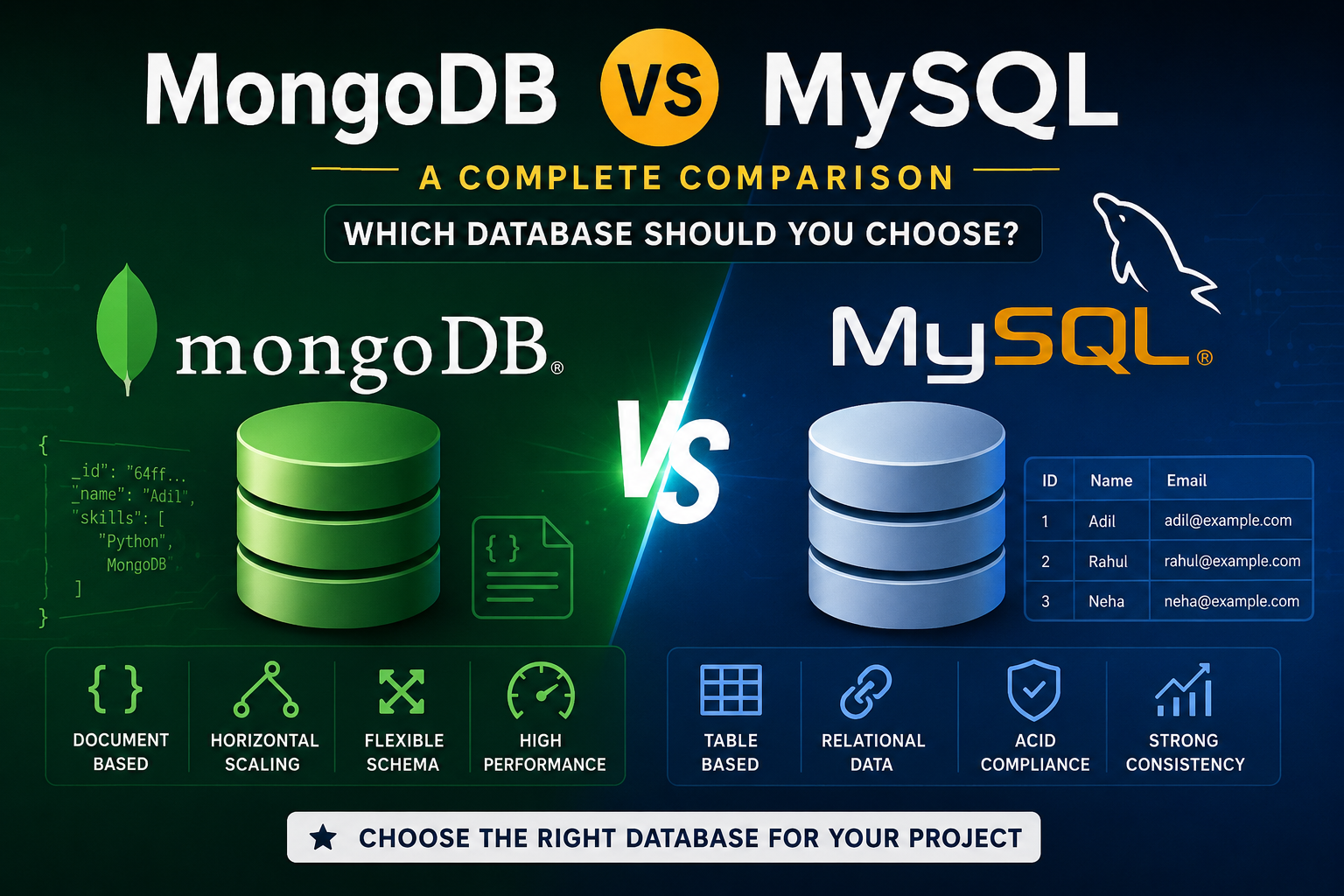
Choosing the right database is one of the most important decisions when building a website, web application, mobile app, or enterprise software. Two of the most popular database technologies are MongoDB and MySQL.
MongoDB is a NoSQL document-oriented database, while MySQL is a relational SQL database. Both are powerful, but they are designed for different types of applications.
In this article, we will compare MongoDB vs MySQL based on data structure, performance, scalability, security, flexibility, use cases, and ease of development.
What Is MongoDB?
MongoDB is an open-source NoSQL database that stores data in JSON-like documents using a format called BSON (Binary JSON).
Instead of storing data in rows and columns like a traditional relational database, MongoDB stores information in documents inside collections.
A MongoDB document can look like this:
{
  "name": "Adil",
  "email": "adil@example.com",
  "skills": ["Python", "PHP", "MongoDB"]
}
This flexible structure makes MongoDB popular for modern applications where data can change frequently.
Key Features of MongoDB
- Document-based data storage
- Flexible schema
- Easy horizontal scaling
- High availability through replication
- Powerful query capabilities
- Suitable for large and rapidly changing datasets
- Good support for modern application development
What Is MySQL?
MySQL is one of the world’s most widely used relational database management systems (RDBMS).
It stores data in tables consisting of rows and columns. MySQL uses SQL (Structured Query Language) to create, read, update, and delete data.
For example, a users table might contain:
| ID | Name | |
|---|---|---|
| 1 | Adil | adil@example.com |
| 2 | Rahul | rahul@example.com |
MySQL is commonly used with PHP, WordPress, Laravel, Java, Python, and many other technologies.
Key Features of MySQL
- Relational table-based structure
- SQL support
- Strong data consistency
- ACID transactions
- Powerful joins and relationships
- Mature security features
- Excellent support for structured data
MongoDB vs MySQL: Key Differences
| Feature | MongoDB | MySQL |
|---|---|---|
| Database Type | NoSQL | Relational SQL |
| Data Structure | Documents | Tables |
| Schema | Flexible | Structured |
| Query Language | MongoDB Query Language | SQL |
| Relationships | Embedded documents/references | Foreign keys |
| Scaling | Excellent horizontal scaling | Traditionally vertical, with modern scaling options |
| Transactions | Supported | Supported |
| Best For | Flexible and rapidly changing data | Structured and relational data |
| Data Format | BSON documents | Rows and columns |
| Learning Curve | Relatively easy for developers familiar with JSON | Easy for developers learning SQL |
Data Structure
One of the biggest differences between MongoDB and MySQL is how they store information.
MongoDB
MongoDB stores data as documents.
For example:
{
  "product": "Laptop",
  "price": 55000,
  "brand": "Dell",
  "specifications": {
    "ram": "16GB",
    "storage": "512GB"
  }
}
The structure can be changed without redesigning an entire table.
MySQL
MySQL stores information in predefined tables.
For example:
CREATE TABLE products (
    id INT PRIMARY KEY,
    product VARCHAR(100),
    price DECIMAL(10,2),
    brand VARCHAR(100)
);
This structured approach is useful when your application has clearly defined relationships between different types of data.
MongoDB vs MySQL Performance
Performance depends heavily on the application, queries, indexes, hardware, database design, and workload.
MongoDB can perform very well when applications work with large amounts of document-oriented data and require flexible schemas.
MySQL can perform extremely well for structured workloads, especially when queries involve relationships, indexes, joins, and transactional operations.
Therefore, it is incorrect to simply say that MongoDB is always faster than MySQL or vice versa.
The better database depends on your workload.
Scalability
MongoDB is designed with horizontal scaling in mind. It supports sharding, which allows data to be distributed across multiple servers.
This can be useful for applications that need to handle very large datasets and high traffic.
MySQL traditionally became popular with vertical scaling, where more CPU, RAM, and storage are added to a server. However, modern MySQL deployments can also use replication, clustering, partitioning, and other architectures to scale applications.
For applications that require large-scale distributed data storage, MongoDB can be an attractive option.
Transactions and Data Consistency
MySQL has traditionally been popular for applications that require strong transactional consistency.
For example, banking systems, financial applications, and order-processing systems often require operations where multiple database changes must succeed together.
MongoDB also supports multi-document ACID transactions, so it is capable of handling transactional workloads as well.
However, database design should still be based on the application’s consistency and transaction requirements rather than simply choosing a database because it supports transactions.
Flexibility
MongoDB has a major advantage when it comes to schema flexibility.
Imagine an application where one product has:
- Name
- Price
- Brand
- RAM
while another product has:
- Name
- Price
- Brand
- Screen Size
- Battery Capacity
MongoDB can naturally store these documents with different fields.
MySQL generally requires a more structured schema, which can be an advantage when you want strict control over the data format.
Relationships
MySQL is particularly strong when applications contain many relationships between entities.
For example:
Customers → Orders → Products → Payments
These relationships can be represented using primary keys and foreign keys.
SQL joins make it possible to retrieve related information from multiple tables.
MongoDB can represent relationships using references or by embedding related data inside documents.
For example:
{
  "customer": "Adil",
  "orders": [
    {
      "product": "Laptop",
      "price": 55000
    }
  ]
}
The best approach depends on how the application accesses the data.
Security
Both MongoDB and MySQL provide security features such as authentication, authorization, encryption options, and access control.
However, database security also depends on proper configuration.
Developers should always:
- Use strong passwords
- Restrict network access
- Keep the database software updated
- Use appropriate user permissions
- Encrypt sensitive connections
- Avoid exposing databases directly to the public internet
- Regularly back up important data
Ease of Development
MongoDB can feel natural to developers working with JavaScript and JSON because application objects can map closely to database documents.
For example, a JavaScript object can look similar to a MongoDB document.
MySQL is often preferred by developers who need powerful SQL queries and structured relational data.
If you are building applications with PHP and Laravel, MySQL is a very common choice.
If you are building a Node.js application with flexible document-based data, MongoDB can be an excellent option.
MongoDB vs MySQL: Which One Should You Choose?
There is no universal winner.
Choose MongoDB when:
- Your data structure changes frequently
- You work with document-oriented data
- You need flexible schemas
- You expect large-scale horizontal scaling
- Your application naturally maps to JSON-like documents
- You are building content-heavy or rapidly evolving applications
Choose MySQL when:
- Your data is highly structured
- You have many relationships between entities
- You need complex SQL queries
- Your application relies heavily on relational data
- You need strong transactional workflows
- You are working with WordPress, PHP, Laravel, or traditional web applications
MongoDB vs MySQL for Web Development
For a simple business website, blog, e-commerce website, or PHP application, MySQL is often a practical choice.
For applications such as real-time platforms, large content systems, analytics applications, catalogs with flexible product structures, or applications that naturally work with JSON-like data, MongoDB may be a better fit.
Related post : How to Install React on Linux in 2026: Complete Beginner’s Guide
However, architecture matters more than simply choosing a popular database.
MongoDB vs MySQL for Beginners
If you are a beginner, learning MySQL and SQL is highly recommended because SQL is widely used across many database systems.
Once you understand relational databases, you can learn MongoDB and understand why NoSQL databases use a different approach.
A good learning path is:
- Learn database fundamentals
- Learn SQL
- Learn MySQL
- Understand database normalization
- Learn indexes and query optimization
- Learn MongoDB
- Understand NoSQL data modeling
- Learn when to use SQL vs NoSQL
Conclusion
MongoDB and MySQL are both powerful database technologies, but they solve different problems.
MongoDB is a flexible NoSQL database that works especially well with document-oriented and rapidly changing data.
MySQL is a mature relational database that is excellent for structured data, relationships, SQL queries, and transactional applications.
The best choice is not about which database is universally faster or better. Instead, choose the database that matches your application’s data model, scalability requirements, transaction needs, query patterns, and development ecosystem.
If your application needs structured relational data, MySQL is an excellent choice. If your application needs flexible document-based storage and easy horizontal scaling, MongoDB can be a great option.
Frequently Asked Questions
Is MongoDB better than MySQL?
Not necessarily. MongoDB and MySQL are designed for different types of workloads. MongoDB is strong for flexible document-based data, while MySQL is excellent for structured relational data.
Which is faster, MongoDB or MySQL?
Neither is always faster. Performance depends on database design, queries, indexes, hardware, and workload.
Should beginners learn MongoDB or MySQL first?
For most beginners, learning SQL and MySQL first provides a strong foundation in database concepts. MongoDB can then be learned to understand NoSQL databases.
Can MongoDB replace MySQL?
In some applications, yes. However, MongoDB is not a direct replacement for every relational database workload. The choice should depend on application requirements.
Is MySQL still relevant in 2026?
Yes. MySQL remains widely used for websites, web applications, enterprise systems, and many other software projects.
Final Verdict: MongoDB is a strong choice for flexible, document-oriented applications, while MySQL remains an excellent choice for structured and relational applications. Understanding both will help developers make better database architecture decisions.